- Pages, and a brief that ruled out a fourth
- 3Pages, and a brief that ruled out a fourth
- Real jobsite photographs, no stock
- 17Real jobsite photographs, no stock
- WebP variants generated from them, never upscaled
- 47WebP variants generated from them, never upscaled
Anonymized write-up. The client is not named, and identifying details have been replaced in every screenshot. The figures are counts from the delivered build, not a company's audited business results.
The buyer for structural engineering does not browse. They arrive by referral, or they search for one exact thing: a load test reaction frame, a rock anchor design, a penstock restraint, because they already have the problem and the schedule is already committed.
They are checking two facts. Can this engineer do the specific thing in front of me, and is the license real. Everything else on a website is in the way.
So this site has three pages.
The brief that took pages away
Most website projects start by listing what to add. This one started with what the client ruled out: no project portfolio, no about page, no biography, and no logo, one had been attempted and abandoned.
That last constraint is the interesting one. A site with a missing logo usually announces it: an empty box top-left where a mark should be, or a name set in whatever the theme's heading font happens to be. The brief was that a logo might arrive later and must not force a redesign when it does.
The answer was to make the wordmark type, deliberately, rather than type standing in for a mark. It is set in the same family as the rest of the interface, at the weight the interface uses for a heading, on the sheet's own grid. Nothing is reserved. Nothing is waiting.
A drawing instead of a hero image
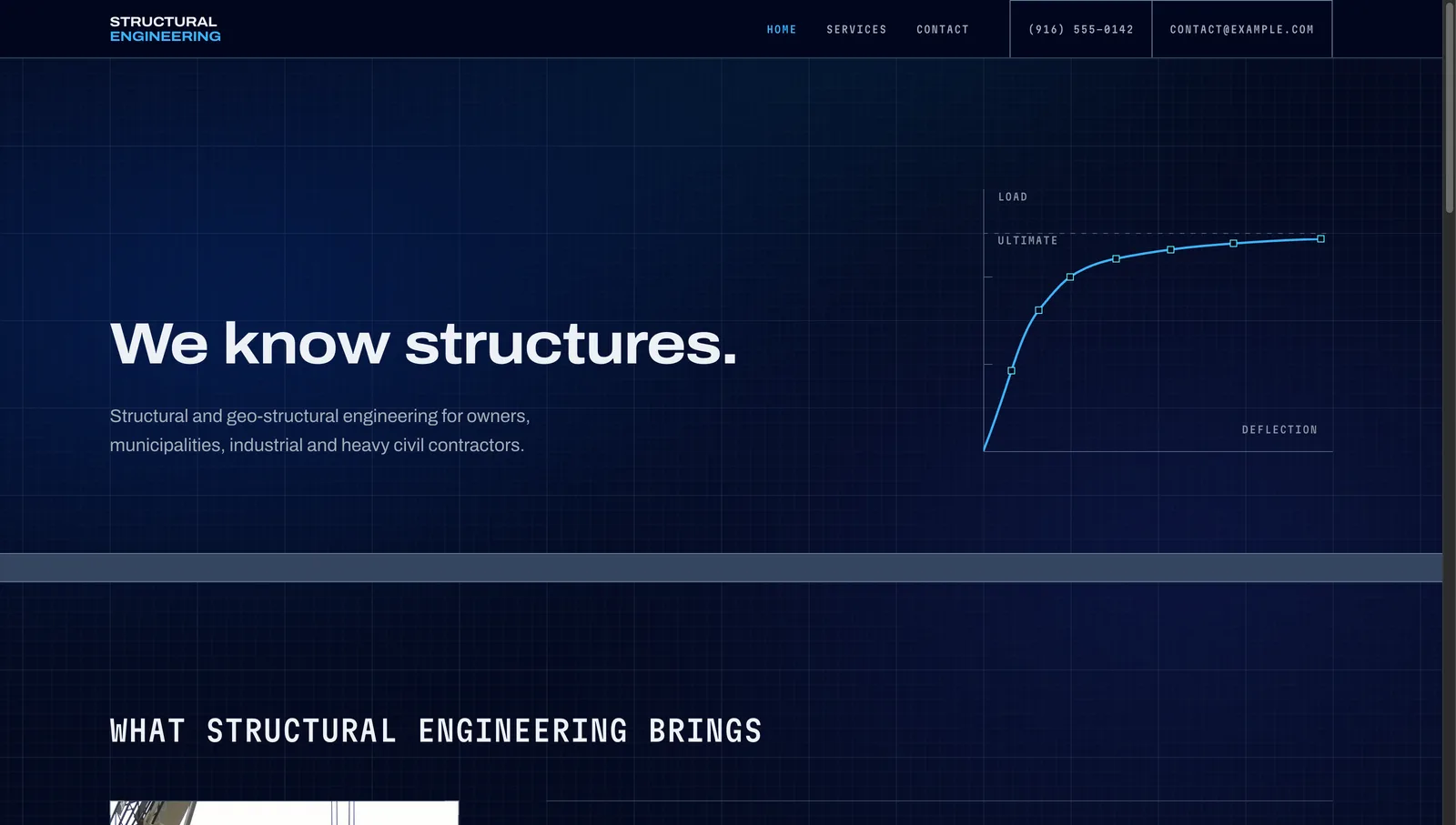
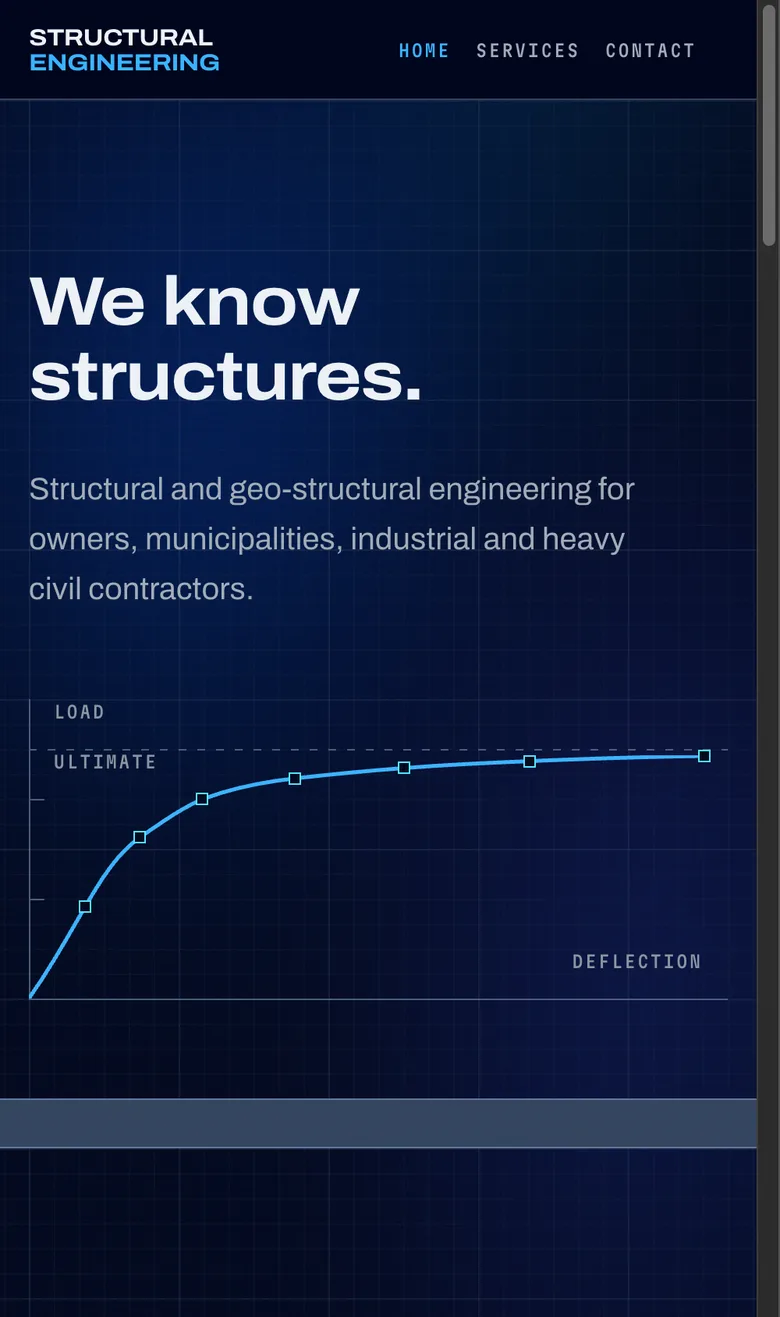
The homepage needed something above the fold that was not a photograph of a crane at sunset. What it got is a load–deflection curve: load climbing almost linearly while the ground is still elastic, bending through the yield knee, then flattening toward an ultimate capacity it approaches and never reaches.
Every buyer on this site has signed one of these. It is the document the whole trade runs on, and it says "we know structures" more credibly than the sentence next to it does.
Two decisions kept it honest.
The axes carry no numbers. No specific load test had been cleared for publication, so the plot diagrams the relationship rather than reporting a result. An engineer reads that immediately; putting invented values on a drawing in front of people who read drawings for a living would have been the fastest way to lose them.
It is ruled by the document, not by itself. The first version drew its own axes and ticks inside the SVG, and at some viewport widths they landed a few pixels off the page's own rules, exactly the amount that reads as a mistake rather than a choice. The plot is now a block of the page's grid: its box is a whole number of divisions tall, its axes are two of the sheet's rules drawn at drafting weight, and only the trace itself scales, carrying a non-scaling stroke so it stays a true hairline at every size.
Photographs that are not allowed to claim anything
Seventeen real jobsite photographs came from the client as multi-megabyte camera JPEGs with inconsistent names and EXIF rotation. They ship as forty-seven WebP variants, generated by a script, at up to three widths each.
- 01
Resize, never upscale
Three target widths, but a source narrower than a target simply does not get that variant, which is why seventeen photographs make forty-seven files and not fifty-one.
- 02
Record the geometry
The script writes a manifest of intrinsic dimensions, so every image reserves its exact box and no photograph can reflow the page as it arrives.
- 03
Sample the tone
It also records each photograph’s average color, so the reserved box holds a plausible tone instead of a gray hole while the bytes are still in flight.
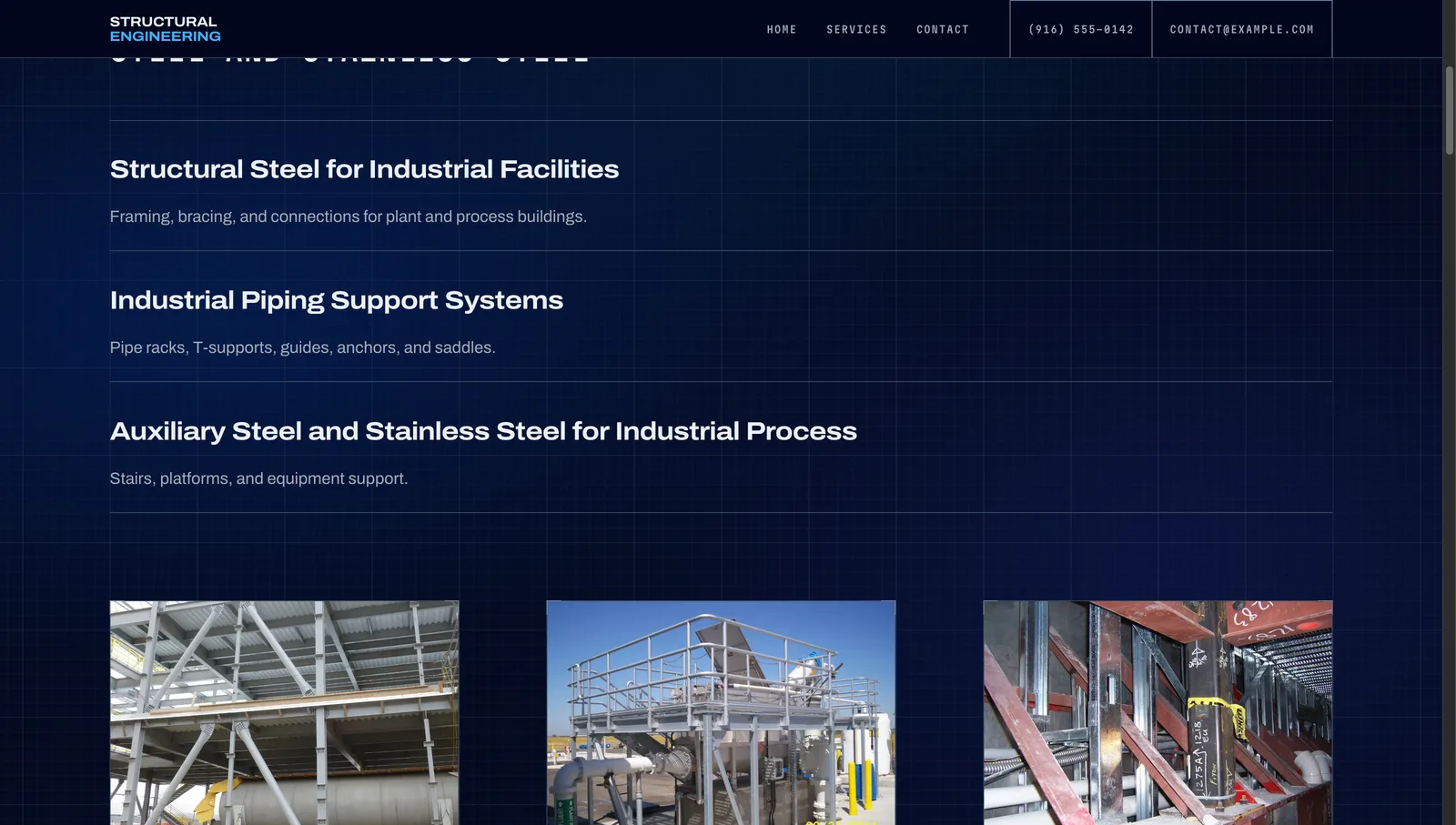
The harder rule was editorial. Until the client supplied a written explanation of what the photographs showed, no caption could claim anything beyond what is plainly visible in the frame. A rebar cage is a rebar cage. It is not "a 40-foot tank foundation for a municipal water district" until somebody who was there says so in writing.
That rule cost the site some good captions. It also means nothing on it can be contradicted by the person who took the photograph.
The vocabulary is the product
The one editorial rule that mattered more than any design decision: the buyer searches for structure types, not industry verticals. "Penstock restraint" and "load test reaction frame" are the words, and they had to survive editing.
They are unglamorous. A copywriter improving this page would soften them into "specialized structural solutions" and the page would stop being findable by the only people it is for. So the capability nouns sit in the headings, at heading size, in the client's own words.
What three pages cost
Nothing, as it turns out, but only because of what was already true about the buyer.
A site can be this short when the reader arrives already knowing what they want, already half-referred, and needing to confirm two facts before picking up the phone. Add a stranger who has to be persuaded from cold and three pages is not enough.
The mistake is building the long version by default. Most of the pages on most professional-services sites exist because the template had slots, not because anybody needed them, and every one of them is a page somebody has to keep true.